


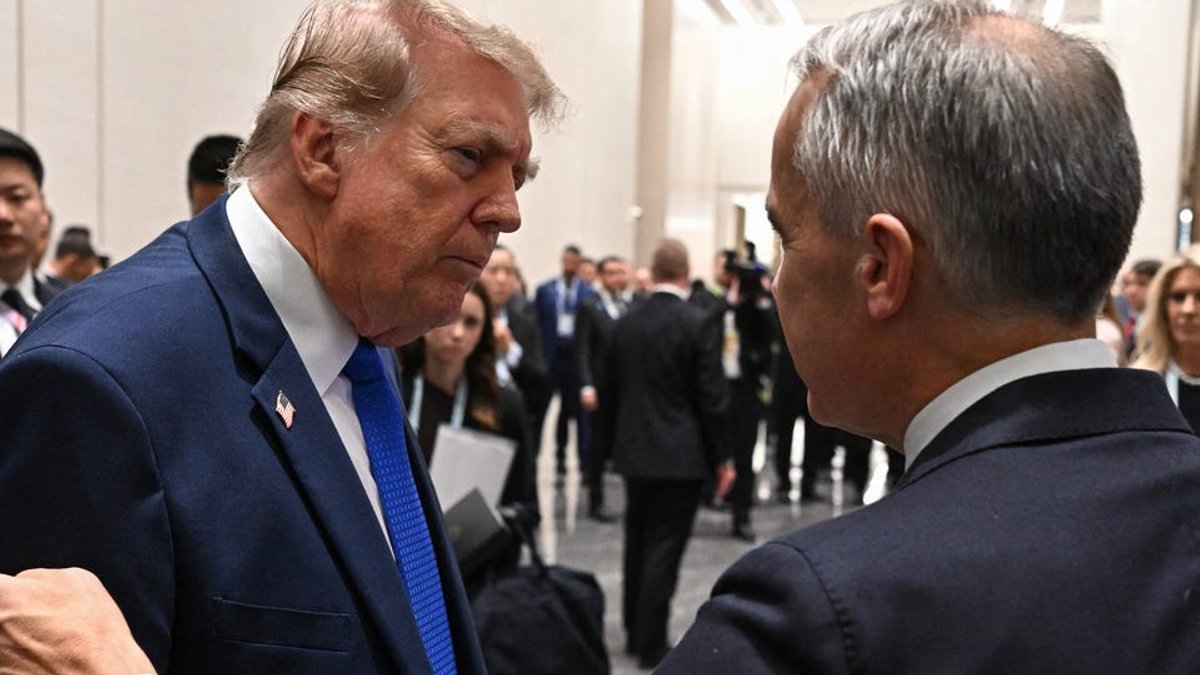
During last week’s APEC summit in Shenzhen, China, President Trump described his meeting with Canadian Prime Minister Mark Carney as “very nice,” yet the talks fell short of preventing his planned 50% tariffs on Canadian-made vehicles, set to take effect in January.
Tariff Talks Stall
Trump also told reporters at the White House last Friday that Canada has been “very difficult” for the United States for 50 years, adding that the country feels emboldened and must not be allowed to continue that behavior because the U.S. can make its own cars.
Canada Rejects U.S. Auto Deal
Carney has pushed back against the threat. Speaking at a Francophile Summit in Phnom Penh, Cambodia, before the APEC meeting, he said he would not sign a trade deal with the U.S. that fails to support a “viable” Canadian auto sector.
Ottawa will look at “other options” in Europe and Asia if its country does not get a fair deal with the U.S. in negotiations, Carney said. One option includes expanding an agreement from earlier this year that lets in 49,000 Chinese electric vehicles with a 6.1 percent tariff.
Asian auto industry expert Michael Dunne of Dunne Insights called the idea a “massive blunder,” arguing that if Carney thinks China will treat him better than the U.S., he is naive.
Trump is not closed to the possibility of letting Chinese vehicles into the U.S. market. He told Fox News in September that if China wanted to open a plant to build cars in the United States, he would be open to that.
Trade Deficit and U.S. Tariffs
The United States trade deficit with Canada is $80 billion, according to Trump’s press conference, though Newsweek notes the official U.S. figure for 2025 was $48 billion. “When it’s down to zero, come over and let’s start talking,” Trump said of his conversation with Carney.
Carney expressed his desire for Canadian auto workers to have optimal opportunities within the North American market. He argued that Trump’s proposed 50 percent tariff would hinder such integration.
Read Also: NASCAR Rookie Zilisch Battles Tough Learning Curve in Debut Season
He is pursuing a temporary deal with the U.S. to reduce Canadian tariffs on imports of steel, aluminum, lumber, and automobiles. Negotiations between the U.S. and Canada to renew the US-Mexico-Canada trade agreement, initiated by the Trump administration, failed to meet the July deadline.
USMCA renewal remains in limbo. If the three countries fail to reach an agreement, the pact stays in effect to July 1, 2036, unless at least one side terminates it earlier. That side would be the U.S., if Trump’s 50 percent tariff takes effect in a bit more than a month.
Stellantis Cuts Canadian Jobs
Canadian autoworkers have already faced setbacks. Stellantis abandoned plans to assemble the Jeep Compass in Brampton, Ontario, relocating production to an Illinois plant. The Brampton plant was sold, resulting in the layoff of 2,200 workers.
Carney called the sale of Brampton, completed on Nov. 9, “unacceptable” and said it violated obligations the automaker made to the government in exchange for taxpayer financing. A spokeswoman said Stellantis is prepared to pay back federal and regional governments for the incentives. Federal accounting records show Stellantis received C$220 million, or about US$155 million, for retooling of the Brampton and Windsor assembly plants.
The Windsor plant, located near Detroit, remains key for Stellantis as the sole production site for the Chrysler Pacifica minivan.
Not including the Brampton plant, production capacity in Canada is 1.65 million units with a 70 percent+ utilization rate, Fiorani said. In addition to assembly plants, GM and Ford operate important Canadian powertrain plants. If Stellantis found an alternative source for the minivan and GM and Ford could move their engine and transmission plants out of Canada, the country’s assembly plants could be at risk.
Canada’s new vehicle sales are projected at 1.9 million this year, significantly lower than the U.S.’s 16 million, making it less attractive for major Chinese investment.
Legislative Hurdles and Future Risks
The Senate has not advanced the Connected Vehicle Security Act. Senators Bernie Moreno and Elissa Slotkin introduced the bill last April. It seeks to ban the import, sale, and operation of vehicles manufactured in China. The bill remains stalled and will not come up for a vote before the Canadian tariff deadline.


