


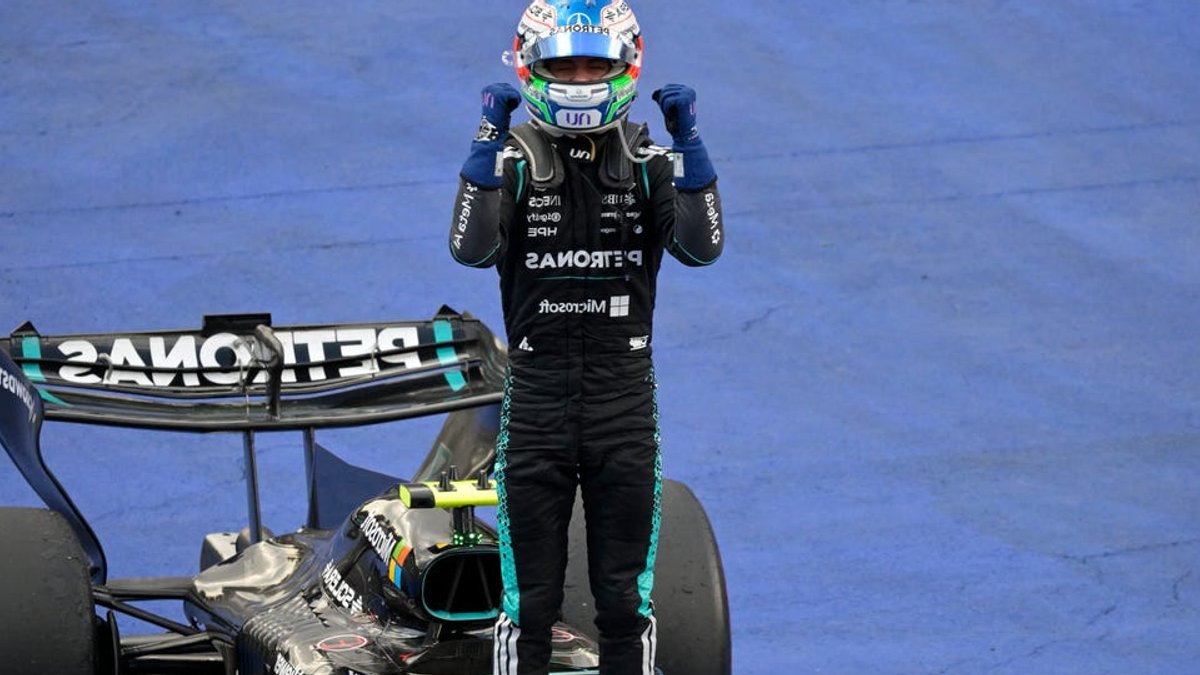
The young Italian delivered a dominant campaign, but his rivals missed critical opportunities at various stages, leaving the championship battle much wider open than it appeared on paper.
Russell’s Slow Start and Mercedes’ Reliability Woes
George Russell began the 2026 season as the top contender and lived up to expectations by winning the first round after securing pole position. However, his performance declined significantly afterwards, with his teammate outperforming him for most of the season. Russell faced numerous issues, including reliability problems that caused him to retire from the lead in Canada and Malaysia, which also affected his performance in Singapore. He experienced mysterious speed problems in Britain and Belgium, and a penalty in Monaco further reduced his points tally.
Russell accepted that “this season just hasn’t meant to be” but emphasized there is no bitterness. He pointed out that he will look back on the areas he could and should have done better, rather than things out of his control. He has, after all, won just twice since the opening round. He believes that his natural driving style has been ill-suited to the requirements of these regulations, and that the convergence of the field has masked the gains he has made since the early chapter of the campaign.
Russell said that he focuses more on the mid- to exit part of the corner, so he is quite aggressive on the throttle pedal, and he focuses a lot on getting the power early. For Antonelli it is the opposite, he attacks the corner more and is often on the power later, which with these new power units as well is not necessarily a bad thing, being on the power later.
The tire pressures this year, especially on the rear, have been very, very high. Pirelli have taken a few PSI margin, especially on the rear axle. This has hindered Russell by pushing his exits, as the rear tire can’t cope with it as well. There has been a bit of a hindrance on the power unit side, as these two factors have really hampered his natural driving style.
Austin, last weekend, was a prime example, where a grim Q3 display was followed by an anonymous race hamstrung by a penalty. Putting some results on the table through the remaining rounds of 2026, and resetting during the winter, is key to ensure he doesn’t already start 2027 as the firm support act.
Ferrari’s Struggles and the Monza Setback
Ferrari looked in the best position to threaten Mercedes’ hegemony during the opening rounds, and its rapid getaways off the line—aided by its smaller turbo—were the catalyst for the yo-yo racing which dominated talk. But Mercedes remained in front, and while the team’s strong chassis and tire strategy facilitated victories in Spain for a rejuvenated Lewis Hamilton and in Britain for Charles Leclerc, it has been another so-so season.
Getting tires into the right window for Q3 has been an issue while the team’s power deficit has proved a season-long disadvantage, and the early benefit of rapid getaways was wiped away by contentious rule tweaks and rivals’ gains. Leclerc appeared Ferrari’s stronger driver early doors and was the best non-Mercedes driver in the standings, but issues under braking robbed him of several weekends, including a couple of premature exits. While that was resolved a high-profile crash in Italy, after a scrappy start, was symptomatic of a driver stuck in a holding pattern.
Read Also: Smith spoils Riggs in Martinsville win
Hamilton’s consistency kept him in contention for the title, and he was only 50 points behind the leader. However, his chances were ultimately dashed by a combination of factors, including a brake failure in Madrid, which led to his first retirement of the year. Ferrari is likely to finish second, but the team still faces challenges in taking the final step to become champions. Despite Hamilton’s strong performance, the team’s inability to maximize every opportunity and the emergence of resurgent rivals have hindered their progress.
McLaren’s Struggles and Norris’ Inconsistency
McLaren conceded early in the year that its launch-spec MCL40 was relatively basic. The team said it would start on the back foot due to its title-winning efforts in 2025. That proved to be the case. The MCL40 has had slow-corner struggles through most of the campaign. It has been draggy, while shorter gear ratios than its competitors have proven to be a baked-in weakness.
As the only one of the leading teams to be a customer outfit, McLaren has been on the back foot regarding the understanding of the new power units. Reliability issues early in the year also proved a hindrance to its prospects. Lando Norris’ title defence started slowly on account of glitches at some stage of all but one of the first six events. These included three non-scorers.
Norris’ challenge eventually got up and running. The MCL40’s sweet spot enabled the champion to fly in Hungary and the Netherlands. He racked up successive wins that hinted at a 2025-style comeback. That was always a long shot, but a hat-trick should have followed at the circuit where passing is impossible. He was skewered by a VSC timing at the track.
Since then, Norris’ strong own performances dropped off amid mistakes and stumbles. This was accentuated by McLaren’s MCL40 proving wildly inconsistent. Strong in-season development was a key factor of McLaren’s resurgence in both 2023 and 2024. That efficacy has not carried over into the new regulations. The efficacy of new components has dropped off.
Verstappen’s Mid-Season Progress
That Max Verstappen has a realistic chance of finishing this year as runner-up says more about his extraordinary mid-season progress. It says less about missing out on the title. Red Bull acknowledged that its big push in the latter half of 2025 compromised its prospects in early 2026. Its RB22 was overweight and struggled for balance.
It did not give its drivers the ideal feel in terms of steering. Verstappen said after his victory in Singapore that the early-season car was sometimes a bit scary to drive. Ill-feeling and overall limitations regularly dropped him into the midfield fight. There were also reliability gremlins and glitches related to the new Red Bull Powertrains-Ford power unit.
These were an understandable setback on the company’s rapid development curve. Verstappen was forced out in China and Monaco due to engine issues. He had poor getaways elsewhere. Instability caused by the rear wing closing incorrectly put him out in Britain. There were also uncharacteristic errors from Verstappen on opening laps in Miami and the Netherlands.


