


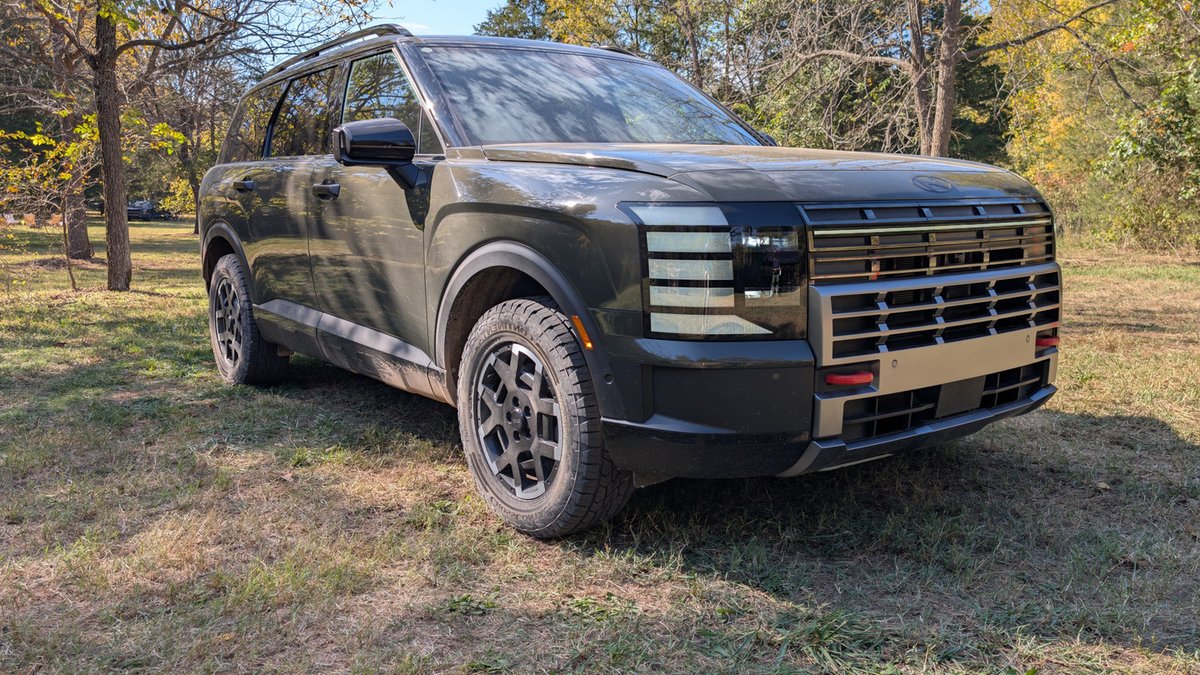
Hyundai has added a serious skid plate to the new Palisade XRT Pro, a detail that signals a shift for the brand. At Rush Springs Ranch, the metal met the dirt and gravel, making a sound that few off-road-themed SUVs ever produce. Most of the Palisade’s history has focused on proving that you do not need a luxury badge to get comfort and space. The XRT Pro changes that, adding hardware that suggests the vehicle is meant for more than just pavement.
Rugged Hardware Meets Family Space
The XRT Pro receives 255/60/18 tires, an inch more ground clearance, and bright front and rear recovery hooks. The standard model sits at 7.4 inches, so the jump to 8.4 inches matters when the wheels leave the ground. The vehicle measures 200.4 inches long, a size that requires care when selecting a line over rocks. Styling communicates adventure, but the footprint still signals a three-row family hauler.
Read Also: BMW Cars to Drive Autonomously in Cities
Inside, the balance between luxury and ruggedness defines the cabin. The second row offers excellent comfort and space, with cool embossing and high adjustability. The third row is a compromise, more suited to children than adults. Charging ports and vents provide basic support for rear passengers. Cargo capacity drops to 19.1 cubic feet with the third row raised, growing to 46.3 cubic feet when folded. Both rows lower manually.
Hyundai equips the XRT Pro with a 3.5-liter V6 producing 287 horsepower and 260 lb-ft of torque. The eight-speed automatic pairs with standard HTRAC all-wheel drive. This system sends power to the front wheels in most situations, relying on an electronic limited-slip differential in the rear. On the trail, the SUV handled loose gravel, uneven sections, and an 18-degree pitch. One tire slipped briefly before the system corrected itself and continued the climb without drama.
On pavement, the XRT Pro feels like a comfortable family SUV, which is where most of these vehicles spend their time. The ride remains plush enough for daily use, and the second row offers a superior feel compared with many competitors in this price range. However, fuel economy is the clearest compromise. The EPA estimates 16 mpg city, 22 highway, and 19 combined (14.7/10.7/12.4 L/100 km). That figure matters for buyers who will use the vehicle for school runs and errands, regardless of how often they venture onto trails.
Read Also: Byron breaks 35-race win drought at Martinsville
Competitors in this space include the Honda Pilot TrailSport, the Ford Explorer Tremor, and the Kia Telluride. Each offers a different approach to the rugged family SUV segment. The Explorer Tremor uses a rear-wheel-drive-biased AWD system, while the Pilot and Telluride focus on cabin fit and everyday comfort. The Palisade XRT Pro manages to keep the family aspect of the purchase intact while adding sincere off-road capability. At around $51,000 including destination, the vehicle presents a strong option for buyers who plan to use the extra capability regularly.
A Comparison with Rivals
The Honda Pilot TrailSport represents a direct rival for the XRT Pro. Both vehicles target families seeking three rows of seating alongside extra capability. The Pilot offers a different approach to traction management. Its system leans toward rear-wheel drive bias, which can benefit drivers who enjoy pushing a vehicle to its limits on pavement. This setup handles uneven surfaces well, though the experience may feel different from a traditional four-wheel-drive system. In the end, the Palisade XRT Pro is a capable off-roader that also delivers on comfort and space, making it a compelling choice for families who want to venture off the beaten path.


